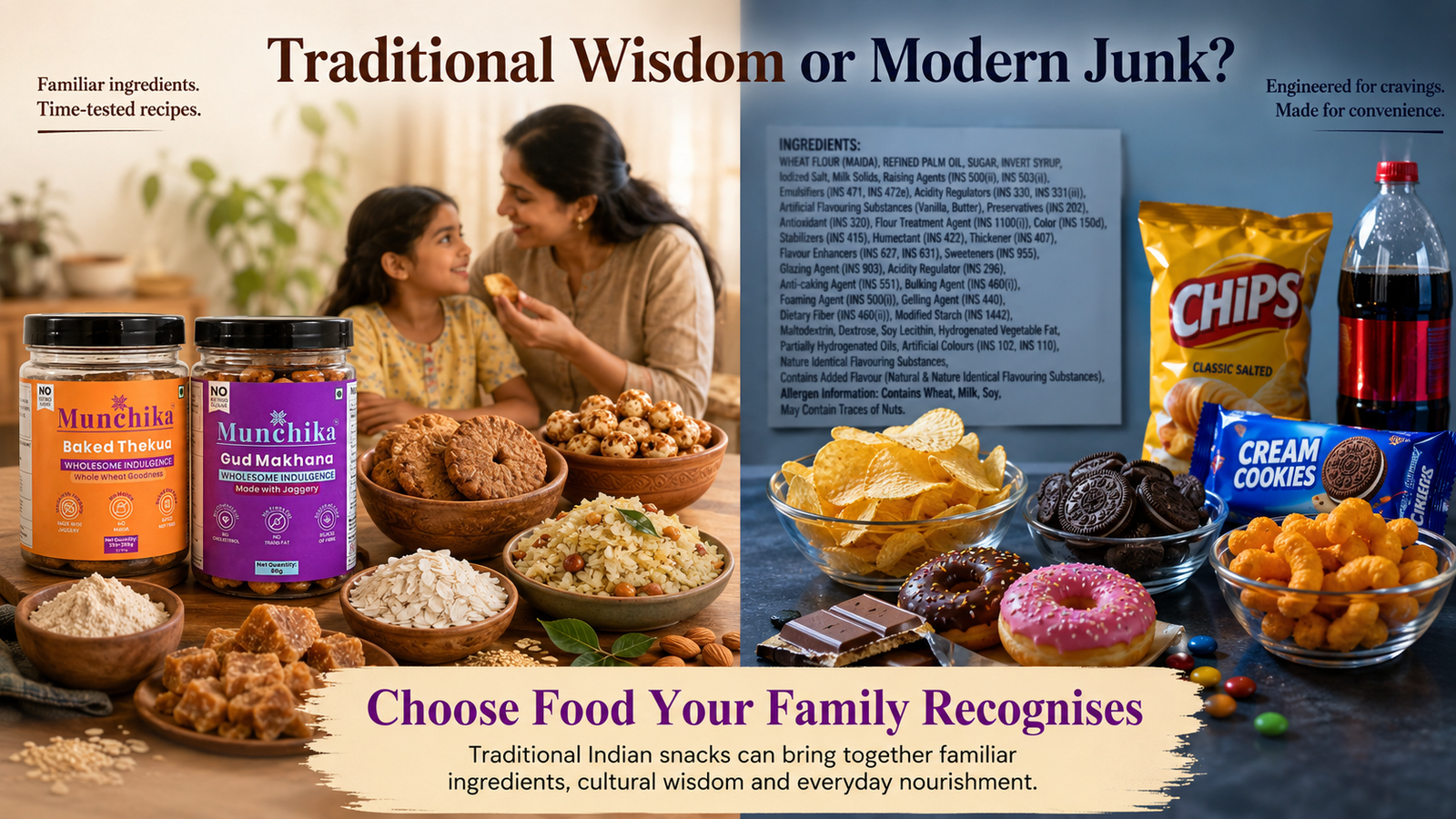
Our grandparents did not count every gram of protein or study complicated ingredient labels. Yet many of the foods they prepared followed principles that modern nutrition science is beginning to appreciate again.
Walk through a supermarket today and the snack aisle appears more advanced than ever.
Packets promise extra protein, added vitamins, “energy,” “fitness,” immunity and instant nourishment. Products are engineered to be crispier, sweeter, cheesier and more convenient. Children are surrounded by colourful packaging, cartoon characters and foods designed to be eaten straight from the packet.
At the same time, many traditional Indian snacks—such as thekua, roasted poha, makhana, chivda, laddoo, roasted chana and millet-based preparations—have slowly moved out of everyday family life.
But did modern snacks actually improve the way we eat?
Scientific evidence increasingly suggests that diets dominated by ultra-processed foods are associated with poorer diet quality and several adverse health outcomes. Traditional foods are not automatically healthy, but recipes based on recognisable grains, pulses, nuts, seeds, spices and minimally processed ingredients can offer families a more balanced foundation.
The real comparison is therefore not simply old food versus new food.
It is:
Ingredient-led food versus formulation-led food.
How a Snack Became a Food Product
Traditional snacks usually began with an ingredient.
Poha began with flattened rice. Thekua began with flour, jaggery, ghee and spices. Chivda combined grains with peanuts, seeds, curry leaves and seasoning. Makhana was roasted and flavoured at home.
Many modern packaged snacks begin differently. They may be designed around refined starches, flavouring systems, added sugars, excess salt, processed fats, emulsifiers and other ingredients required to achieve a particular taste, texture or shelf life.
This does not mean that every packaged food is harmful or that processing itself is bad.
Grinding grain, roasting makhana, fermenting dosa batter, baking thekua and flattening rice into poha are all forms of processing. In fact, traditional food cultures have always processed ingredients.
The concern is ultra-processing—when the original food becomes a small part of an industrial formulation designed for convenience, long shelf life and high palatability.
What Research Says About Ultra-Processed Food
In a controlled study conducted at the US National Institutes of Health, adults were given either an ultra-processed or minimally processed diet for two weeks and then switched to the other diet. Although the meals were designed to contain similar amounts of presented calories, sugar, fat, sodium, fibre and macronutrients, participants ate more calories and gained weight during the ultra-processed phase. They lost weight during the minimally processed phase.
This matters because it suggests that nutrition cannot always be understood by looking only at the numbers printed on a label. The structure, texture, eating speed and formulation of a food may also affect how much we consume.
A large 2024 umbrella review published in The BMJ examined multiple meta-analyses and found that greater exposure to ultra-processed food was consistently associated with a higher risk of several adverse outcomes. The strongest evidence concerned conditions such as type 2 diabetes, overweight and obesity, cardiovascular outcomes, common mental disorders and premature mortality. The authors also stressed that much of the evidence was observational, meaning it shows association rather than proving that every ultra-processed product directly causes disease.
That distinction is important. Science does not support panic or blanket statements.
But it does support a sensible question:
Should foods designed for occasional convenience become the default everyday diet of a family?
The Hidden Cost: What Junk Food Replaces
The problem with junk food is not only what it contains.
It is also what it pushes out.
When a child regularly fills up on sugary drinks, highly refined snacks, cream-filled biscuits and salty packaged foods, there may be less appetite and less room for grains, pulses, fruits, vegetables, nuts, seeds and balanced meals.
Research has associated higher consumption of ultra-processed foods with lower dietary diversity and lower intake of several micronutrients. Studies involving children and women have similarly found that higher ultra-processed-food intake tends to accompany lower consumption of healthier foods and greater intake of nutrients associated with non-communicable disease risk.
A child may receive plenty of calories and still have a diet lacking in variety and nutrient density.
This is one reason why weight alone is not a complete measure of nourishment.
Food and Children’s Growth: More Than Protein
Growth requires energy and protein, but it also depends on minerals, vitamins, essential fats and overall diet quality.
A population study involving children aged 2–18 found that better nutritional adequacy and higher intakes of several macro- and micronutrients were associated with better height-for-age measurements. The study was observational and cannot prove that individual foods made children taller, but it supports the broader principle that growth relies on a varied, nutrient-dense diet—not one fashionable nutrient in isolation.
No traditional snack can guarantee a child’s growth. No protein cookie can either.
The useful role of a thoughtfully prepared traditional snack is that it can contribute ingredients such as:
- Whole or less-refined grains
- Pulses and legumes
- Peanuts, almonds and cashews
- Sesame, flax and other seeds
- Makhana
- Spices and herbs
- Dairy, ghee or suitable oils
- Fruits or jaggery in moderated quantities
The benefit comes from the overall pattern and variety, not from declaring one ingredient a superfood.
The Practical Intelligence Behind Traditional Indian Food
Traditional Indian food developed through generations of observation, availability and adaptation.
It should not be romanticised as perfect or treated as medical science. Yet many traditional food practices show practical intelligence that aligns with modern nutritional understanding.
1. Combining Grains and Pulses
Indian food rarely depended on a single ingredient to provide everything.
Dal was paired with rice. Roti was eaten with pulses, curd or vegetables. Idli and dosa combined rice with urad dal. Khichdi brought cereal and legume together in one dish.
Cereal and pulse proteins have different amino-acid profiles. Research on cooked cereal-pulse combinations has found that combining them can improve overall protein quality compared with relying on either category alone.
This does not mean that every meal must contain a “complete protein” combination. A varied diet across the day can meet amino-acid needs. But it shows that traditional meal combinations were often more nutritionally balanced than they first appeared.
This is food intelligence—not protein obsession.
2. Soaking, Sprouting, Fermenting and Malting
Traditional kitchens used time as an ingredient.
Grains and pulses were soaked. Batter was fermented. Seeds were sprouted. Millets were malted. These processes changed flavour and texture, but they could also change the nutritional characteristics of the food.
Research on millet processing has found that germination and fermentation can improve certain nutritional properties and nutrient availability, while excessive polishing, milling and dehulling can reduce fibre and micronutrient content.
A systematic review on millets also reported that traditional processing methods such as fermentation and germination may improve the bioavailability of iron.
The traditional kitchen did not use scientific terms such as “bioavailability” and “antinutritional factors.” But many of its methods were practical ways of making grains and pulses easier to use, digest and enjoy.
3. Using the Whole Ingredient
Traditional foods often retained more of the original ingredient.
A grain remained visible as a grain. A nut remained a nut. Seeds were roasted and added. Curry leaves, fennel, cumin, sesame, coconut and spices could still be identified in the finished food.
By contrast, excessive refining may remove fibre-rich outer layers and micronutrients. Research on millet processing specifically notes that heavy polishing and milling can reduce dietary fibre and nutrient content.
This is why the ingredient list matters.
A product with ten familiar kitchen ingredients is fundamentally different from one built mainly from refined flour, starch, flavouring and sugar—even when both packages display similar health claims.
4. Building Diversity Into Everyday Eating
Indian food culture did not revolve around one heroic nutrient.
Different grains appeared across regions: wheat, rice, jowar, bajra, ragi and other millets. Pulses varied from moong and masoor to chana and urad. Nuts, seeds, vegetables, spices and fermented foods added further diversity.
Millets, for example, can provide carbohydrates, protein, fibre, minerals and phytochemicals. Their precise nutritional value depends on the variety and how they are processed and prepared.
Traditional diversity offers a useful lesson for modern families:
Do not ask one food to provide everything. Build a varied diet in which different foods contribute different strengths.
5. Eating Food in Context
Traditional snacks usually had a place and purpose.
Some were packed for journeys because they kept well. Some were prepared for festivals. Some accompanied evening tea. Some were given during seasonal or family occasions.
They were rarely marketed as unlimited, all-day foods.
Modern snacking has removed many of those boundaries. Food is available while watching television, studying, driving, scrolling or working. Because ultra-processed snacks are convenient and easy to eat quickly, consumption can continue without much awareness.
Bringing back traditional food should also mean bringing back intentional eating—serving a portion in a bowl, sitting down and actually tasting the snack.
Traditional Does Not Automatically Mean Healthy
A credible conversation must acknowledge this clearly.
Some traditional snacks are deep-fried. Some contain large amounts of salt, sugar or ghee. Jaggery is still an added sugar. A homemade sweet does not become unlimited simply because it is traditional.
Similarly, a modern packaged food is not automatically unhealthy. Frozen vegetables, pasteurised milk, fortified foods and safely packaged staples can be useful and nutritious.
The better question is not:
“Is this traditional or modern?”
It is:
“What is it made from, how was it prepared, and how often are we eating it?”
A traditional recipe prepared with excessive sugar or repeatedly heated oil may not be a good everyday choice. But a traditional-style snack made with recognisable ingredients, sensible portions and better cooking methods can be a meaningful alternative to conventional junk food.
Do Not Become a “Protein Paglu”
Protein is essential. Children, adults and older people all need adequate protein.
But modern food marketing often treats protein as though it were the only nutrient that matters.
Biscuits, chips, cereals, desserts and drinks are increasingly sold as “high protein,” even when the overall formulation may still contain refined starches, sweeteners, excessive sodium or numerous additives.
A product does not automatically become wholesome because protein has been added to it.
Indian diets already contain many familiar protein sources:
- Dal and pulses
- Milk, curd and paneer
- Nuts and seeds
- Roasted chana
- Peanuts
- Soy foods
- Eggs and other animal foods for families that consume them
- Grain-and-pulse combinations
The goal should be adequate protein within a varied diet—not turning every eating occasion into a protein competition.
Food is also fibre, minerals, vitamins, fats, carbohydrates, culture, satisfaction and family memory.
How Families Can Make the Shift
Moving away from junk food does not require banning every packet overnight.
It begins by changing what is easiest to reach.
Make traditional snacks more visible
Keep roasted makhana, chana, nuts, poha mixes, baked traditional snacks or homemade preparations where children can see them.
Read the ingredient list before the claims
Ignore the front of the packet for a moment. Look at the back.
Can you recognise the main ingredients? Is the food primarily made from grain, pulse, nut or seed—or from refined starches, sugar and flavouring?
Choose better preparation methods
For regular snacking, prefer roasted or baked choices more often than deep-fried alternatives.
Serve portions instead of handing over the jar
Traditional does not mean unlimited. Place a suitable quantity in a small bowl or tiffin.
Let children develop familiarity
Children may not immediately choose thekua, poha or makhana over highly flavoured chips. Repeated, pressure-free exposure can help traditional flavours become normal rather than unfamiliar.
Keep the whole diet in perspective
A snack cannot compensate for an unbalanced diet. Meals, fruits, vegetables, pulses, grains, dairy or suitable alternatives and adequate hydration still matter most.
Bring Tradition Back—Without Leaving Convenience Behind
Modern families need convenience. There is no value in making parents feel guilty because they cannot prepare every snack from scratch.
The answer is not to reject packaging or modern food technology.
It is to use them more thoughtfully.
Traditional recipes can be standardised, prepared safely, packed conveniently and adapted through roasting or baking—without losing their identity or turning them into heavily engineered formulations.
At Munchika, this is the idea behind Everyday Tradition: bringing familiar Indian snacks into modern family life using known ingredients, traditional flavours and no preservatives or unnecessary additives.
We do not believe that every snack must become a supplement.
Sometimes, a better snack is simply one your family recognises.
A snack whose ingredients make sense.
A snack that connects children with the foods their parents grew up eating.
And a snack that proves convenience and tradition do not have to be opposites.
The Choice on the Snack Shelf
The shift from traditional food to junk food did not happen in one day.
It happened one packet, one advertisement and one convenient choice at a time.
The return can happen in the same way.
One bowl of roasted makhana instead of chips.
One portion of poha mix instead of an artificially flavoured snack.
One baked thekua with evening tea instead of another cream-filled biscuit.
These are small choices. But repeated across a family, they influence children’s tastes, habits and understanding of food.
Our ancestors did not create perfect diets. But they left us a rich food culture built around variety, recognisable ingredients, practical preparation methods and recipes refined across generations.
Modern science does not tell us to copy the past blindly.
It gives us good reasons not to abandon it carelessly.